
What Is Express Consent in Colorado? DUI Test Refusal Rules
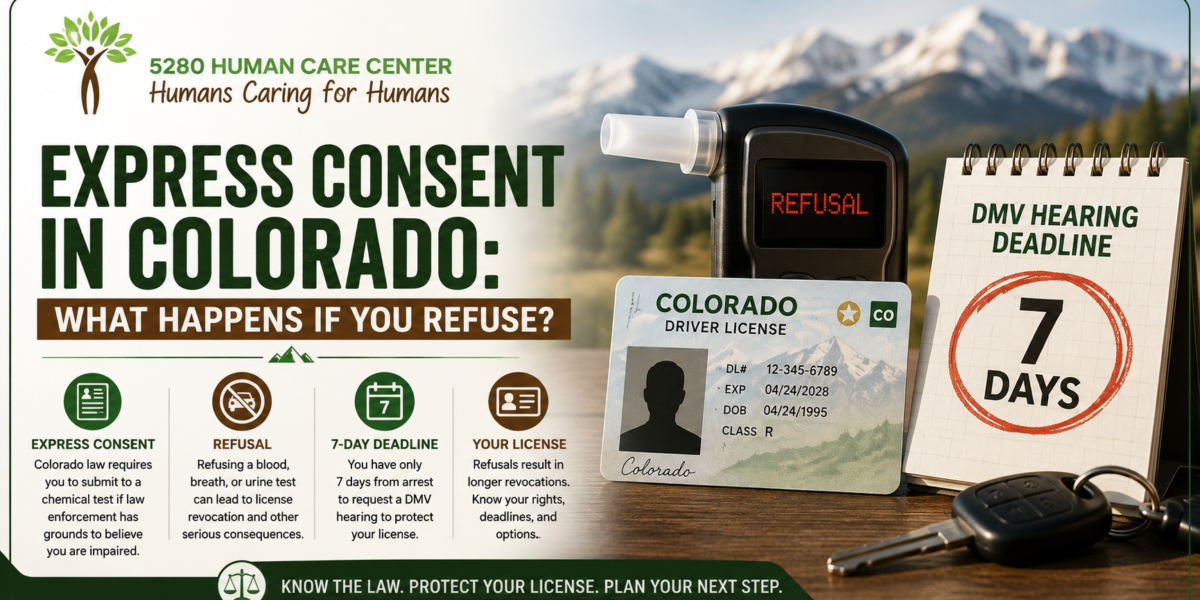
“Express Consent” in Colorado means that by driving on Colorado roads, you implicitly agree to provide a chemical sample—blood or breath—for testing if a law enforcement officer lawfully arrests you on suspicion of impairment. (Colorado Department of Revenue)
Under Colorado Revised Statutes § 42-4-1301.1, holding a state license or driving on Colorado roads means you automatically agree to take a blood, breath, urine, or saliva test if an officer has probable cause for a DUI or DWAI arrest.
Colorado’s Express Consent Law means drivers are deemed to have consented to a required chemical test when an officer has probable cause or reasonable grounds to believe the driver was impaired by alcohol, drugs, or both.
Refusing or failing to cooperate with the required test can trigger a separate Colorado DMV license revocation. For a first refusal, the standard revocation is one year, and a refusal also results in a Persistent Drunk Driver designation. A driver generally has only seven days to request a DMV hearing after a refusal notice.
What Is Express Consent in Colorado?
Colorado Revised Statutes § 42-4-1301.1 is formally titled the Expressed Consent law. In everyday use, it is commonly called Colorado’s Express Consent Law.
Under the law, a person who drives a motor vehicle in Colorado is deemed to have consented to the testing provisions of the statute. When law enforcement has probable cause to believe a driver was DUI, DWAI, or otherwise driving while impaired by alcohol, drugs, or both, the officer may require an appropriate chemical test.
The Colorado DMV summarizes the rule this way: drivers must cooperate with the chemical-testing process requested during an alcohol- or drug-related DUI investigation. Refusal or noncooperation can result in a separate administrative driver’s-license revocation.
Express consent does not mean police may demand a chemical test during every traffic stop.
The law’s testing requirements are tied to an impaired-driving investigation and the legal grounds required by Colorado law. The exact testing process can also differ depending on whether alcohol, drugs, or a combination of substances is suspected.
Is a Roadside Breath Test the Same as the Express Consent Test?
No. This is one of the most important distinctions on the page.
| Test | What It Is | Does It Satisfy Express Consent? |
|---|---|---|
| Roadside PBT | A preliminary breath screening test that may be used during the investigation. | No. Colorado DMV specifically states that a roadside PBT does not satisfy the required chemical-testing process. |
| Evidentiary Breath Test | A formal breath test administered as part of the DUI chemical-testing process. | Yes, when properly requested and completed. |
| Blood Test | A blood sample obtained at an officer’s request for evidentiary testing. | Yes, when properly requested and completed. |
What Happens If You Refuse a Breath or Blood Test in Colorado?
A refusal can create consequences that are separate from whatever ultimately happens in criminal court. Colorado DMV treats refusal to cooperate with the required chemical-testing process as an administrative driver’s-license matter.
The DMV also treats refusal as a Persistent Drunk Driver (PDD) event. That designation can affect reinstatement requirements and may require Level II alcohol and drug education and treatment.
How Long Is the License Revocation for Refusing a Chemical Test?
Colorado DMV currently lists the standard refusal revocation periods as follows:
| Refusal | Standard Revocation | Early Reinstatement |
|---|---|---|
| First refusal | 1 year | Some Colorado residents age 21+ may be eligible after serving 2 months if all other requirements are met and ignition interlock is installed. |
| Second refusal | 2 years | Early reinstatement may be available in some circumstances after the required waiting period and satisfaction of DMV conditions. |
| Third refusal | 3 years | Eligibility is more complicated and depends on the person’s driving record and other restraints. |
These are administrative revocation periods. A person’s actual reinstatement date can be later if there are additional restraints or if reinstatement requirements have not been completed.
How Long Do You Have to Request an Express Consent Hearing?
The deadline is short.
Colorado DMV generally gives a driver seven days to request a hearing after a refusal or other qualifying DUI administrative action.
The timing of that seven-day period depends on the type of testing. For a refusal or breath test, it is generally measured from the DUI arrest. For a blood test, it can begin when the driver receives notice of the blood-test result.
A DMV hearing is an administrative proceeding. If the hearing is requested properly and on time, a hearing officer reviews whether the legal requirements for the revocation were established.
Colorado DMV currently allows hearing requests through MyDMV Colorado.
Is the DMV Express Consent Case the Same as the Criminal DUI Case?
No. The Colorado DMV case and the criminal DUI case are separate proceedings.
A person can be dealing with an administrative driver’s-license revocation while a separate DUI or DWAI case proceeds through the court system. An outcome in one process does not automatically resolve every issue in the other.
That separation is one reason DUI cases can become confusing. Court requirements, probation requirements, driver’s-license reinstatement requirements, education, treatment, ignition interlock, and insurance requirements may overlap without being identical.
Can a Chemical-Test Refusal Trigger Level II Education and Treatment?
Yes. Colorado DMV identifies refusal as one circumstance that can require a Level II alcohol and drug education and treatment program for driver’s-license reinstatement.
The appropriate Level II Therapy track depends on the driver’s circumstances and prior history. Colorado’s current DMV matrix includes refusal within its placement criteria for certain tracks.
If Level II Therapy is required in addition to education, learn more about Colorado Level II DUI Therapy and the Tracks A-D structure before enrolling.
Can You Reinstate Your Colorado Driver’s License Early After a Refusal?
Sometimes. Colorado DMV states that certain Colorado residents who were age 21 or older at the time of the violation may be eligible for early reinstatement after a refusal if they meet the applicable conditions.
For a first refusal, DMV currently describes potential early reinstatement after two months of revocation when the driver has no other disqualifying restraints and installs an ignition-interlock device in every vehicle the person owns or may drive.
Reinstatement requirements may also include SR-22 insurance, a reinstatement fee, and proof of enrollment in or completion of required alcohol and drug education and treatment.
Because reinstatement is highly record-specific, use Colorado DMV reinstatement information or MyDMV to verify the requirements that apply to your driving record.
Does Express Consent Apply to Marijuana and Other Drug DUIs?
Yes. Colorado’s Express Consent framework is not limited to alcohol. The statute covers testing related to suspected impairment by alcohol, drugs, or combinations of substances.
The type of testing may differ depending on what law enforcement has probable cause to believe is causing impairment. For drug-related investigations, blood, urine, or saliva testing may be relevant under Colorado law.
For more on cannabis-specific DUI issues, see our resource on Marijuana DUI in Colorado.
Frequently Asked Questions About Express Consent in Colorado
Is Colorado an implied-consent state?
Colorado uses the statutory term Expressed Consent. In practical terms, drivers are deemed to have consented to the chemical-testing provisions of C.R.S. § 42-4-1301.1 when the legal requirements for an impaired-driving investigation are met.
Can I refuse a chemical test after a Colorado DUI arrest?
A person may physically refuse or fail to cooperate, but Colorado DMV can impose significant administrative consequences for that refusal, including driver’s-license revocation and a Persistent Drunk Driver designation.
Does refusing a chemical test automatically mean I am convicted of DUI?
No. A refusal and a criminal DUI conviction are not the same thing. The DMV administrative process is separate from the criminal court case, although refusal evidence may have consequences in the criminal proceeding.
Is a roadside breathalyzer the Express Consent test?
No. Colorado DMV specifically states that the roadside preliminary breath test does not satisfy the required chemical-testing process. A later evidentiary breath or blood test may still be requested.
How long do I have to request a DMV hearing after refusing?
Colorado DMV generally requires the hearing request within seven days. Because the deadline is short, review the notice you received immediately.
Does a first refusal mean I can never drive for a full year?
Not necessarily. Although the standard first-refusal revocation is one year, some eligible Colorado residents age 21 or older may qualify for early reinstatement after serving two months and satisfying ignition-interlock and other reinstatement requirements.
Will I need Level II classes after refusing a chemical test?
Possibly. Colorado DMV lists refusal as a circumstance that can require Level II alcohol and drug education and treatment for reinstatement. The exact education and therapy requirements depend on the individual’s driving history and placement criteria.
Need Help Understanding Your DUI Education or Treatment Requirements?
Express Consent issues can lead to separate court, DMV, ignition-interlock, insurance, education, and treatment requirements.
5280 Human Care Center can review your referral or DUI-program paperwork and help you identify the Colorado DUI education or therapy program you need before you enroll.